If you’ve ever walked through a manufacturing plant at 2 a.m., the kind where the hum of heavy machinery drowns out all other noise and the air smells faintly of metal, chemicals, or melted plastic, you’ve probably felt the steady, unobtrusive hum of industrial chillers doing their work. I’m the owner of an industrial cooling equipment supplier, and for 12 years, I’ve talked to plant managers, production leads, and process engineers who see chillers as either a critical lifeline or an afterthought—until they fail. A chiller isn’t just a box that makes cold water. It’s the backbone of thousands of processes that keep our world running, and understanding where they show up might make you see one in a whole new light. Industrial Cooling Equipment
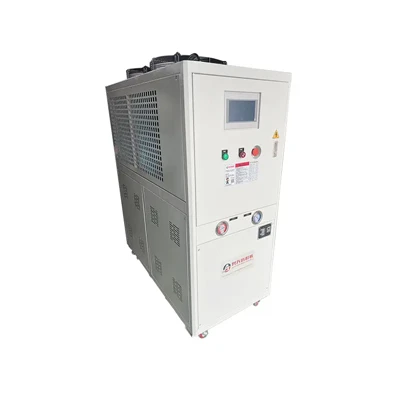
Let’s start with the manufacturing space, because that’s where most people first encounter industrial chillers, and it’s also where their most foundational work happens. For the automotive industry alone, chillers handle two of the most energy-intensive parts of production: metal forming and plastic injection molding. When a car body panel is stamped from a steel roll, the stamping press exerts thousands of pounds of force, and the friction generated would warp the metal, damage the tooling, and ruin the part if not managed. A chiller circulates precise-temperature water through the press’s die and the surrounding tooling, drawing off excess heat so the metal cools evenly as it’s shaped. Without that, a single shift could ruin dozens of panels, halt production for hours, and cost a small fortune in downtime.
Then there’s injection molding, used for everything from toy parts to bumper components and even the small plastic housings inside your phone. When molten plastic is injected into a mold, it has to set perfectly to avoid warping, cracking, or having an uneven surface. Too much heat in the mold, and the plastic stays soft; too little, and it doesn’t fill the mold evenly. Industrial chillers deliver water that’s calibrated to within a fraction of a degree—sometimes just half a degree Fahrenheit—to the mold’s cooling lines, ensuring every part is consistent. I once worked with a small automotive parts supplier in Ohio that tried to cut costs by switching to a less reliable local cooling system for their molding presses. Within three months, their defect rate jumped 18%, they missed two major delivery deadlines, and nearly lost a contract that made up 40% of their revenue. That’s the kind of impact a chiller’s reliability has.
Moving beyond automotive, the pharmaceutical and biotech industries rely on chillers in ways that are almost invisible but non-negotiable. These spaces aren’t just about making pills—they’re about maintaining sterility, stability, and the efficacy of products from raw material to finished good. For example, when manufacturers produce liquid or powdered medications, they often use fermentation tanks to grow bacteria or yeast that produce the active pharmaceutical ingredients (APIs). Those microbes are extremely sensitive to temperature: a 2-degree shift in a 10,000-gallon fermentation tank can kill the desired culture, ruin an entire batch, and waste months of work and raw materials. Industrial chillers circulate cooling jackets around these tanks, regulating temperature 24/7 to keep the cultures in their ideal range.
Then there’s freeze-drying, a critical process for vaccines, antibiotics, and even certain food products that require long shelf lives. Freeze-drying works by freezing a product, then reducing the pressure around it so water sublimates out without melting it. The entire process happens in large, insulated chambers, and maintaining consistent low temperatures throughout is key to preserving the product’s structure and efficacy. Chiller systems designed for freeze-drying can cool those chambers to well below freezing, and adjust temperature slowly and evenly to avoid damaging the product. I’ve visited a vaccine manufacturing facility in Belgium that has 12 large freeze-drying chillers running year-round; they told me that a single chiller failure during a production run could cost upwards of $2 million, plus delay shipments that are critical for global health initiatives. Food and beverage processing has a whole host of applications for chillers too, many of which people don’t think about. Take dairy processing, for example: milk has to be cooled immediately after milking to 40°F (4°C) or below to prevent bacterial growth, and that’s often done with a chiller system that circulates cold water through bulk milk tanks. Without that, milk would spoil before it even reaches the processing plant.
Beyond dairy, chillers are central to making everything from canned goods to craft beer, and even frozen foods. When brewing beer, the fermentation process produces a lot of heat, and yeast only works within a narrow temperature range. A chiller cools the fermenters, ensuring the yeast does its job without producing off-flavors. For craft breweries, that consistency is everything—one batch with off-tasting beer could hurt their reputation irreparably. Even large-scale soda production uses chillers to cool syrup and carbonated water, keeping the CO2 dissolved and ensuring the final product has the right fizz. Frozen pizza, ice cream, and ready-to-eat meals all rely on chillers to cool products during processing, packaging, and freezing before they’re stored or shipped.
Now, let’s talk about the tech sector, which is one of the fastest-growing areas for chiller applications, especially as data centers and semiconductor manufacturing expand. Data centers are powerhouses of heat—thousands of servers running 24/7 generate massive amounts of heat, and if that heat isn’t removed, servers overheat, crash, and can be permanently damaged. Ten years ago, many data centers used air cooling, but as server density has increased, that’s become insufficient. Modern data centers use industrial chillers to circulate cold water through heat exchangers, pulling heat away from the servers and either releasing it outside or repurposing it for heating nearby buildings. A single large data center can use dozens of chillers, and their efficiency directly impacts the data center’s operational costs—cooling can make up 40% of a data center’s total energy use, so choosing the right chiller is a big part of keeping costs low.
Semiconductor manufacturing is even more demanding. Semiconductors are made in clean rooms where every variable—temperature, humidity, air purity—has to be controlled to extreme levels. When silicon wafers are etched, coated, and processed into chips, any temperature fluctuation can cause defects that ruin the entire wafer. A single 1-degree shift during the photolithography stage, where tiny circuit patterns are printed onto the wafer, can render thousands of chips unusable. Industrial chillers for semiconductor facilities have to be able to maintain temperature to within 0.1 degrees Celsius, sometimes even less. These chillers also have to be extremely reliable, because a clean room running at full capacity is one of the most expensive places to have downtime—an hour of downtime in a 10,000-square-foot semiconductor clean room can cost tens of thousands of dollars, and a full week of downtime can set production back months.
I could go on about other applications, but let’s not forget two often-overlooked areas: commercial and institutional cooling, and environmental applications. In large office buildings, hospitals, and universities, central chiller systems are the standard for cooling large spaces. Trying to cool a 50-story office building with individual air conditioners would be inefficient and costly, so a single chiller system that circulates cold water to air handlers throughout the building is much more effective. Hospitals have even stricter requirements: operating rooms, intensive care units, and pharmacy storage areas need precise temperature control, and chillers have to be backed up with redundant systems to avoid any interruptions—something I learned early on when a local hospital’s chiller failed during a summer heatwave, and they had to rent temporary chillers at a premium to keep operating rooms cool.
Environmental applications might surprise you, but they’re growing. For example, in carbon capture and storage (CCS) systems, which are designed to capture CO2 emissions from power plants and industrial facilities, chillers are used to cool flue gases and capture the CO2 efficiently. The process works by cooling the gas so that CO2 can be separated, and having a reliable, energy-efficient chiller is key to making CCS feasible. Then there’s geothermal power, which uses heat from the earth to generate electricity. Chiller systems help regulate the temperature of the geothermal fluid as it’s pumped through pipes, ensuring consistent performance of the power plant. Even in aquaculture, where fish are raised in large tanks, chillers are used to maintain the water temperature at the ideal level for different species, from tropical fish to salmon in cold-water tanks.
Working in this industry for as long as I have, I’ve learned that the best chillers aren’t just the most powerful or the cheapest—they’re the ones that are matched to the specific needs of the application. A chiller for a small injection molding shop has very different requirements than one for a semiconductor clean room, and a system for a pharmaceutical fermentation tank is nothing like one for a data center. That’s why I always take the time to talk through a client’s specific process, their budget, their downtime requirements, and their long-term goals, not just sell them a standard unit.
I’ve seen too many clients make the mistake of buying a chiller based solely on upfront cost, only to end up paying more in downtime, repairs, and lost production. Last year, I worked with a plastics manufacturer in Texas that had a 10-year-old chiller that was constantly breaking down. They were quoted a new, cheap unit from a national brand, but when we analyzed their production, we found they needed a unit with redundant compressors and remote monitoring, because they couldn’t afford even an hour of downtime on their high-volume molding lines. We ended up working with them to design a custom system that fit their needs, and their defect rate dropped 12% in the first three months, while their energy use went down 18%. That’s the kind of result that makes all the technical work worth it.
If you’re a plant manager, process engineer, or business owner looking for a cooling solution that’s reliable, efficient, and tailored to your specific needs, reach out to connect with our team to discuss your requirements. We’ll work with you to assess your process, analyze your cooling needs, and provide a solution that fits your budget and long-term goals. We pride ourselves on building long-term partnerships, not just selling equipment, and our team has the expertise to support you through installation, maintenance, and any future upgrades you may need.
Chiller Unit References
- American Society of Heating, Refrigerating and Air-Conditioning Engineers (ASHRAE). 2021. Industrial Refrigeration Handbook.
- U.S. Department of Energy. 2022. Industrial Chiller Systems: Energy Efficiency Opportunities.
- International Society for Pharmaceutical Engineering (ISPE). 2020. Guide to Good Manufacturing Practices for Pharmaceutical Products.
- Semiconductor Industry Association. 2021. Semiconductor Manufacturing Facility Design and Operations.
- Brewing Industry Guide. 2023. Temperature Control in Fermentation: Best Practices for Craft and Commercial Breweries.
Kunshan Aotianxin Machinery Co., Ltd.
We’re well-known as one of the most reliable industrial cooling equipment manufacturers in China. With abundant experience, our factory offer high quality industrial cooling equipment made in China with low price. If you have any enquiry about quotation and free sample, please feel free to email us.
Address: 550 Shengguang Road, Bacheng Town, Kunshan City, Jiangsu Province
E-mail: 1516722561@qq.com
WebSite: https://www.atxks.com/
